Right whale
The WhaleThe Right whale is a baleen whale whose anatomy once made it unusually profitable to hunt and whose habits still expose it to human danger. In the history traced here, it moves from a conspicuous presence in Cape Cod Bay and a foundation of the Nantucket fishery to a species protected by law but not assured of survival. Its story links the practical details of feeding and floating to a larger reversal: features that once made the animal valuable now help explain its vulnerability.
Identity and Feeding
Right whales belong to the mysticetes, or baleen whales, rather than the toothed odontocetes. Mysticetes filter plankton and small fish from the water through baleen. Their feeding method differs from the toothed whales’ pursuit of prey one fish at a time: baleen whales take mouthfuls of water and food, then strain out the water. In Cape Cod Bay, the Right whale shares its feeding grounds with several other mysticetes, including the Minke whale, the Humpback whale, and the Fin whale.
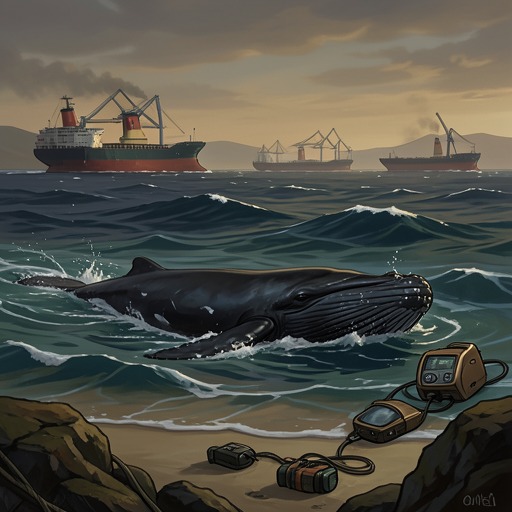
Its body and behavior help define its coastal presence. Right whales carry a large proportion of their weight as fat, which makes them buoyant; they spend much of their time near the surface and float after death. Their tendency to follow shorelines earned them the name urban whale. Those traits made the animals relatively easy for hunters to locate and handle, but the same preference for busy coastal waters brings them into contact with modern shipping.
Nantucket and the Whaling Economy
The Right whale was among the first whales hunted in the waters around Nantucket. Before the island’s settlers developed a large fishery, Nattick people had foraged for whales in the region, and the newcomers learned from their techniques. Early hunters watched for migrating Right whales from land masts fitted with crude ladders. Once a whale was harpooned, it was towed back to the beach, where its thick blubber could be rendered into oil.
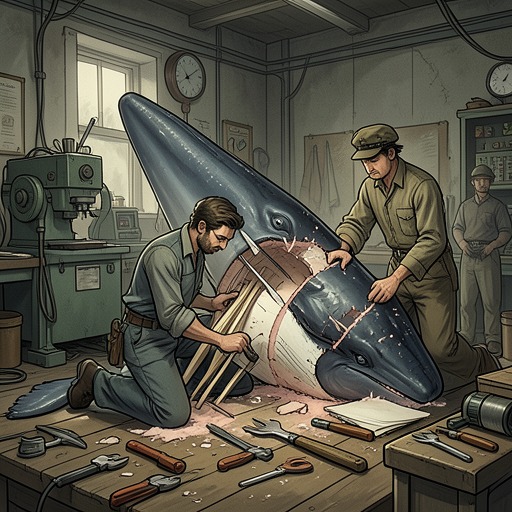
The animal’s commercial value extended beyond its blubber. Its baleen was long and fine, and could be fashioned into useful goods. In the period when the Nantucket fishery expanded, the Right whale’s abundance and the practical advantages of hunting it helped make the surrounding waters a source of livelihood. The book’s account also places baleen in the material life of whaling: the pliable plates could be made into umbrellas, corset stays, venetian blinds, and brush bristles. Whale oil served as fuel, while baleen served as a kind of plastic.
In 1712, according to the legend recounted in the book, Christopher Hussey encountered a Sperm whale after a storm carried his sloop beyond the usual limits of the Nantucket fishery. The discovery shifted the islanders’ attention toward the deeper-water quarry. As the Sperm whale became central to the expanding business and Right whales grew scarcer, Nantucket’s fleet increased; by 1730 it numbered twenty-five vessels, and by the end of the eighteenth century the island led the world in whaling. This change did not end the Right whale’s importance, but it placed its early role within a broader and increasingly far-reaching extraction of whales.
Body, Value, and Decline
The very characteristics that made the Right whale profitable compounded the pressure on it. Its plentiful blubber yielded oil, and its long baleen could be processed into a range of products. Because the animals stayed close to shore and floated when killed, hunters could exploit them with methods that were comparatively accessible. The book emphasizes the irony: what made these whales the right ones to catch also made them especially exposed to human predation.
By the time the Nantucket fishery encountered mounting difficulties in the 1840s, Right whales had become scarcer. The island’s harbor was silting up, and larger ships needed for longer voyages could not readily cross its dangerous sandbar. Whaling increasingly favored New Bedford and the Pacific, while other forces were transforming the market. Petroleum and gas altered demand for whale oil, and Edwin L. Drake’s 1859 oil well at Titusville signaled a new source of fuel and a further change in the economy of extraction. Later, the explosive harpoon and steam-powered pursuit opened other whale populations to industrial hunting; the account notes that Right whales and Sperm whales had already been depleted to the point that their pursuit was no longer commercially viable.
Protection and Uncertain Survival
The Right whale became the first cetacean protected from hunting, in 1935. International restrictions followed amid growing concern about the scale of whaling, including the 1936 conference in Oslo and the expanded conference in London in 1937. In 1982, the International Whaling Commission instituted a worldwide moratorium, which took effect in 1987 after a delay for whaling nations to comply. Such rules mark a change in human treatment of whales, but protection from hunting has not removed the dangers created by human activity.
The account reports fewer than 400 North Atlantic Right whales remaining and describes a population that had not grown despite protective measures. Shipping lanes were moved farther north, and vessels were instructed to stay 500 yards from whales, yet ship strikes continued to take a toll, including on females of breeding age. More than 60 percent of Right whales had been caught in fishing line, another threat that can be difficult to see in the animal’s crowded coastal habitat. The species’ inherited diversity is also severely narrowed: the account identifies only eight surviving matrilineal lines in the northern population.
The book presents the future of the Right whale as uncertain rather than secured. Its closeness to populous shores and busy shipping routes turns its old coastal advantage into a modern liability; static numbers, restricted inheritance, entanglement, and vessel strikes together threaten its prospects. In that reversal, the Right whale becomes more than a record of the old whale-oil economy: it is a measure of how a species can receive legal protection while still bearing the consequences of the industries and environments humans have made.